
Blog
Friend or Foe? Why the Yellow Garden Spider is Your Florida Garden’s Best-Kept Secret
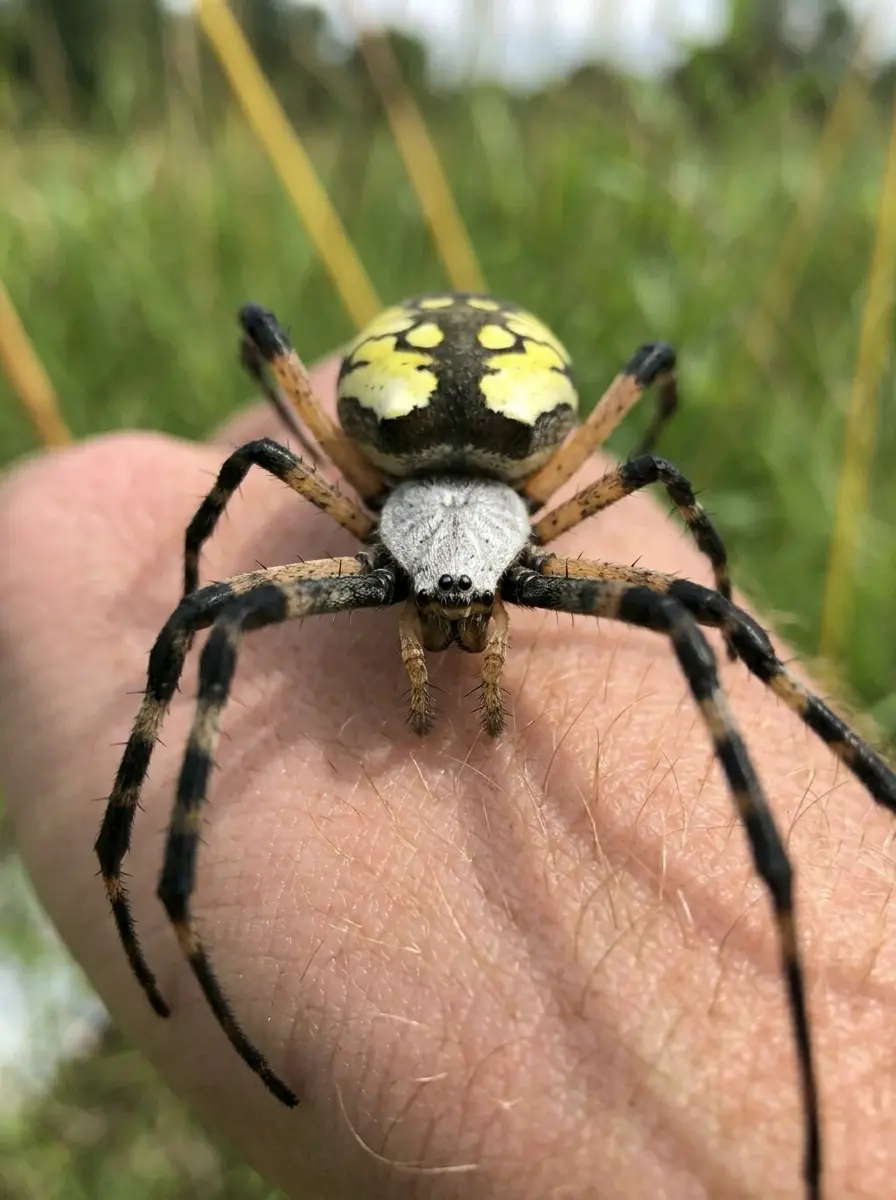
The “Writing Spider”: Myth vs. Reality
You walk out to your garden one morning and there it is: a spider the size of your palm, hanging in an elaborate web strung between your tomato plants, decorated with a bold zigzag of silk you could spot from ten feet away. Your first instinct might be to grab the nearest shoe. Your second, if you can pause long enough, should be to say thank you.
The Yellow Garden Spider (Argiope aurantia) is one of the most visually striking arachnids in North America, and in Florida, it is also one of the most valuable. Before we get to what it does for your garden, let’s clear up the stories that have been attached to it for generations.
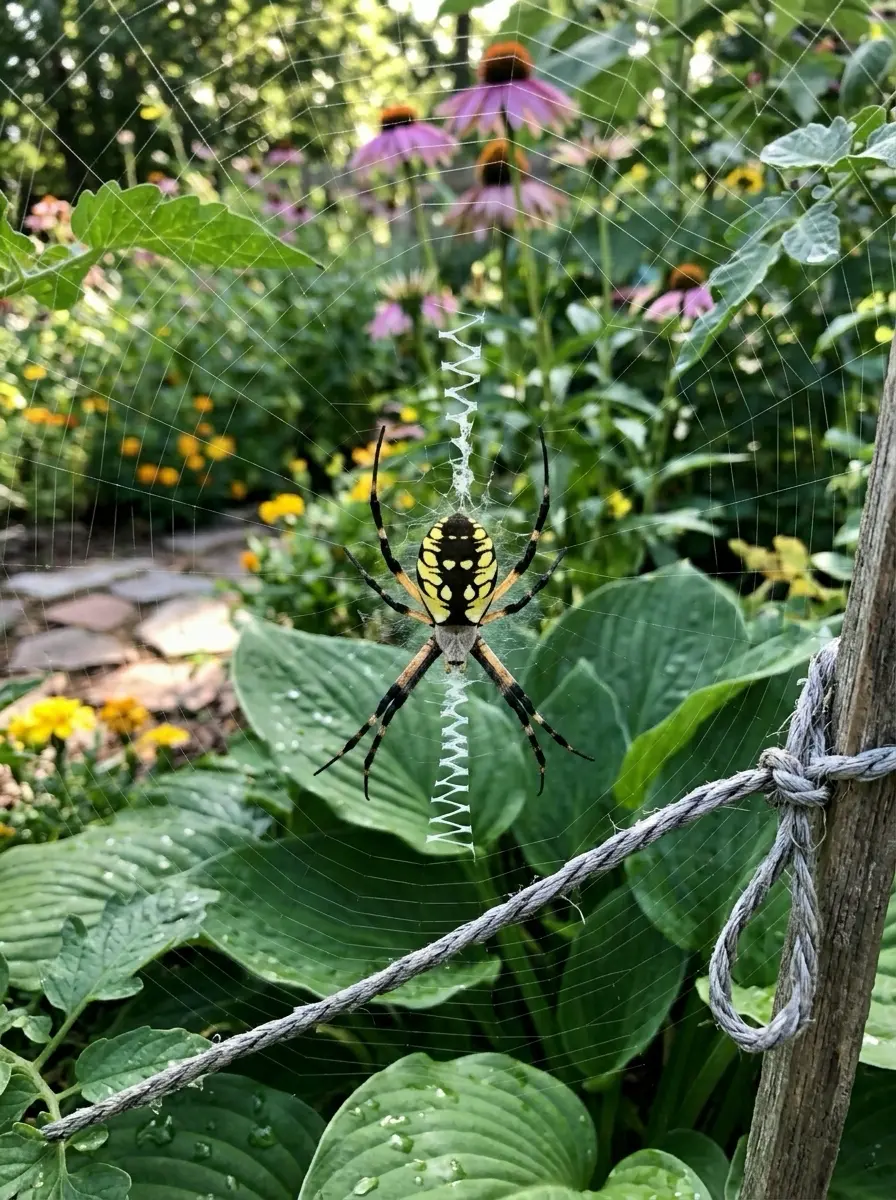
The Stabilimentum: What Is That Zigzag?
The yellow garden spider’s web is famous for its central zigzag pattern, technically called a stabilimentum. Folklore across the American South holds that this “writing” contains a message or a name, which is why the spider earned its most affectionate nickname: the Writing Spider. Some traditions even suggested that if your name appeared in the web, misfortune was coming.
The reality is more interesting than any myth. The stabilimentum is a structural and functional silk feature whose exact purpose scientists are still studying. Leading theories include that it reflects ultraviolet light to attract insect prey, that it makes the web visible enough to prevent large animals (like you) from blundering through it, and that it may help stabilize the web’s central structure in high-airflow environments. Florida’s abundant sunshine and frequent afternoon breezes make it a particularly common sight here.
The “writing” in the web is not a message for you. It is a precision hunting tool that has been refined over millions of years of evolution. The spider that built it is not an omen. It is a neighbor doing you an enormous favor, free of charge.
Debunking the Fear
“Yellow garden spiders are dangerous. That size and those markings are a warning sign. They will bite if you get near them.”
Argiope aurantia is non-aggressive. It has venom used to immobilize insect prey, but its bite on a human, which requires deliberate provocation to trigger, causes only mild, localized discomfort similar to a bee sting. There are no medically significant cases of Yellow Garden Spider envenomation on record.
“If I see one, there must be an infestation. I need to call an exterminator.”
Yellow garden spiders are solitary. One spider in your garden is almost always exactly that: one spider. They are seasonal, appearing most prominently in late summer and fall, and their presence signals a healthy garden ecosystem, not a pest problem.
“They are invasive or unusual. Something must have changed in the environment.”
Argiope aurantia is native to North America and has been a natural resident of Florida gardens for as long as there have been Florida gardens. Seeing one is perfectly normal and actually indicates your outdoor space is providing good habitat.
“Those bright yellow and black colors mean it’s venomous and deadly, like a wasp.”
The bold coloration is indeed a form of warning display, but it is directed at birds and larger predators, not humans. The spider uses it to appear larger and less edible. To you, it is simply a beautiful, harmless garden resident.
Why the Yellow Garden Spider Is a Florida Gardener’s Asset
Understanding what a Yellow Garden Spider eats is the fastest way to appreciate why you want one in your garden. These are generalist predators that capture whatever flying and jumping insects make contact with their webs, which in Florida means they are intercepting exactly the pests that cost gardeners the most time, money, and frustration.
This is the foundation of Integrated Pest Management (IPM), a science-based approach to garden pest control that prioritizes natural biological controls before chemical intervention. The Yellow Garden Spider is one of the most efficient IPM assets Florida gardeners have access to, and it shows up entirely on its own, requires no maintenance, and costs nothing to operate.
What They Actually Eat: Florida’s Most Unwanted Garden Guests
Mosquitoes
Small, lightweight, and abundant in Florida. Orb webs placed in garden vegetation intercept mosquitoes actively seeking hosts and resting sites in the foliage.
Whiteflies and Gnats
Two of Florida’s most persistent vegetable garden pests. Their small size and erratic flight patterns make them highly susceptible to orb web capture.
Grasshoppers
Florida’s grasshoppers can defoliate garden plants rapidly. The Yellow Garden Spider is one of the few natural predators large enough to effectively capture and subdue them.
Beetles and Weevils
Many Florida garden beetle species are captured in webs near ground-level vegetation. The spider’s strong silk restrains even hard-bodied insects effectively.
Aphid-Hosting Flies
Aphid midge flies and leaf miner adults are intercepted before they can lay eggs on host plants, breaking the reproductive cycle of two of Florida’s most damaging soft-bodied pests.
Cabbage Moths and Loopers
Adult moths captured before egg-laying prevents the larval stage that causes direct damage to brassicas, tomatoes, and pepper plants in Florida vegetable gardens.
To put this in perspective: a single female Yellow Garden Spider living through her active season from July through November can remove hundreds to over a thousand individual insects from your garden. No pesticide application is that targeted, that selective, or that affordable.
The Web as a Hunting Tool: Engineering in Silk
The orb web of Argiope aurantia is not a passive trap. It is a precision instrument built and maintained with deliberate strategy, and understanding how it works makes the spider’s behavior much easier to observe and appreciate.
Yellow garden spiders always choose web sites with maximum sun exposure and good air circulation. In Florida, this means south or east-facing openings in vegetation where morning sun hits first. This placement maximizes the UV reflectance of the stabilimentum and puts the web in the flight paths of sun-seeking insects. If the spider in your garden moves its web, watch where the new one goes. It is not random.
The spider does not watch for prey with its eyes. It sits at the center of the web, always facing downward, with its front legs resting on signal lines that transmit vibrations from the outer web. When an insect makes contact with the sticky spiral threads, the characteristic struggle pattern tells the spider the size, location, and direction of the prey before it ever moves toward it. This is why the spider always knows exactly where to go and rarely misses.
Each evening, the Yellow Garden Spider eats most of the sticky spiral portion of its web, reabsorbing the protein-rich silk and recycling it into new thread overnight. By morning, a fresh, perfectly sticky spiral is rebuilt in the same frame. This daily recycling means the web is always at maximum stickiness and structural integrity, and it is an extraordinary example of biological resource efficiency. The radial “spoke” threads and stabilimentum are typically left in place and reused as the foundation.
When prey is captured, the spider moves to it quickly, bites to inject venom that immobilizes the insect within seconds, and immediately begins wrapping it in silk. The wrapping comes first to prevent escape, and the actual feeding happens later at the spider’s center position. This sequence protects the spider from being stung or bitten by struggling prey and preserves the prey fresh for extended consumption.
Addressing Common Concerns
Are they dangerous to children or pets?
Argiope aurantia is classified as harmless to humans and animals by every major toxicology and arachnology resource. The spider is non-aggressive by nature: its default response to a perceived threat is to drop from the web and hide in surrounding vegetation, not to attack. It will only bite as an absolute last resort if it is physically pinched or squeezed and cannot escape. Even in that scenario, the bite produces mild, localized redness and discomfort, comparable to a bee sting, with no systemic effects. Children who are taught to look and not touch can observe these spiders safely from just a few feet away. Pets that investigate the web are far more likely to destroy it than to provoke a bite.
Harmless to children and petsWhat if the web is in a high-traffic area?
If the spider has built its web across a frequently used path or in a location where people will regularly walk through it, gentle relocation is a completely reasonable solution. Use a long stick or gardening stake to support the web from below, gradually encouraging the spider to move onto the stick, then carry it to a sheltered spot in a less-trafficked area of the garden with similar sun exposure. Do this slowly and the spider will typically grip the stick rather than drop. Alternatively, simply guide the anchor lines of the web to a slightly different attachment point using a stick. The spider will usually rebuild in the new position overnight. Avoid using gloves or touching the spider directly, as this is the most likely scenario for a defensive bite.
Relocate gently, do not killShould I spray to get rid of it?
No, and there are two compelling reasons why. The first is that it is genuinely counterproductive. The Yellow Garden Spider is removing pest insects from your garden at a rate no residential pesticide application can match, and it is doing so with zero chemical residue on your vegetables, flowers, or soil. Killing it removes a natural control system that took the season to establish. The second reason is broader: pesticide applications in garden beds are rarely spider-specific. They also kill beneficial insects including pollinators, predatory wasps, ground beetles, and other spiders that are all working on your behalf. If the spider’s location is the issue, relocate it. If its presence is the issue, the information above should offer some reassurance.
Avoid pesticides entirelyLiving in Harmony: Tips for a Spider-Friendly Florida Garden
If one Yellow Garden Spider is doing measurable good, a garden that actively supports a community of beneficial spiders and predatory insects is genuinely more resilient, lower-maintenance, and healthier overall. Here is how to build that kind of garden.
Leave Undisturbed Areas
Yellow garden spiders prefer garden margins: areas where managed garden beds meet rougher, wilder vegetation. Leave some sections of your fence line, back corners, or garden edges slightly wild. Tall ornamental grasses, native shrubs, and flowering perennials at the garden’s edge provide ideal anchor points for webs and shelter for overwintering egg sacs. See our guide to ornamental grasses for Florida-appropriate options.
Reduce Broad-Spectrum Pesticide Use
Broad-spectrum pesticides do not distinguish between pest insects and the predators that control them. In a garden treated regularly with pyrethroid sprays, the first populations to collapse are the beneficial ones, because they are less prolific and take longer to recover than the pests they control. Switching to targeted treatments applied only to confirmed infestations, and only to affected plants, preserves the spider and insect community that provides ongoing natural pest control.
Reduce Outdoor Lighting Near Garden Beds
Outdoor lights attract insects at night, which in turn concentrates spider activity around light sources. If your landscape lighting is positioned directly over vegetable beds or flowering plants, consider redirecting it. Keeping insect activity distributed across the garden rather than concentrated near artificial light sources supports a healthier distribution of predator activity and reduces moth egg-laying near light-adjacent plants.
Plant for Insect Diversity
A garden that supports diverse insect life supports diverse predator life. Florida-native flowering plants like Firebush, Pentas, Blanket Flower, and Blue Mistflower attract a wide range of flying insects that in turn supply food for spiders, insectivorous birds, lizards, and predatory wasps. A biologically diverse garden is self-regulating in a way that a monoculture or heavily chemically managed garden simply cannot be. See our native perennials guide for plant choices by Florida region.
Protect the Egg Sac in Fall
Female Yellow Garden Spiders lay their eggs in late summer or fall in a papery, brown, football-shaped egg sac attached near the web. The female typically dies with the first cold snap, but the egg sac overwinters successfully and releases hundreds of spiderlings in spring. If you find an egg sac in your garden and are tempted to remove it, consider leaving it. Next season’s garden spider population depends on it, and none of those spiderlings will be large enough to be visible for most of the following year.
Observe Rather Than Intervene
The Yellow Garden Spider is one of the most watchable animals in a Florida garden. Its daily web maintenance, hunting behavior, and the mechanics of prey capture are visible to the naked eye. For children especially, spending a few minutes watching a garden spider work is a genuine and free nature education that builds the kind of ecological appreciation that shapes how people think about their environment for the rest of their lives. You do not need to go anywhere. The garden is already doing the work.
Quick Identification Guide: Yellow Garden Spider vs. Common Look-Alikes
Florida is home to dozens of spider species, and it helps to know what you are looking at. Here is how to distinguish Argiope aurantia from other common garden spiders at a glance.
| Spider | Size | Key Feature | Web Type | Concern Level |
|---|---|---|---|---|
| Yellow Garden Spider (Argiope aurantia) | Up to 1.1 inches (female) | Bold yellow and black abdomen; zigzag stabilimentum in web | Large orb web in open vegetation | Harmless |
| Banded Garden Spider (Argiope trifasciata) | Up to 0.8 inches | Silver and yellow banded abdomen; similar stabilimentum | Orb web close to ground in grasses | Harmless |
| Golden Silk Orb-Weaver (Trichonephila clavipes) | Up to 1.5 inches (female) | Orange and brown body; distinctive tufts on legs; golden-colored silk | Large, golden-tinted orb web in woodland edges | Harmless |
| Spiny Orb-Weaver (Gasteracantha cancriformis) | Under 0.5 inches | White or yellow with red or black spines; very small | Orb web with tufts of silk on frame lines | Harmless |
| Black Widow (Latrodectus mactans) | Under 0.5 inches (body) | Shiny black with red hourglass marking on underside | Irregular, tangled web in dark sheltered spots | Medically Significant |
| Brown Recluse (Loxosceles reclusa) | Under 0.5 inches (body) | Tan to brown; violin-shaped marking on back; 6 eyes | Irregular web in undisturbed indoor/sheltered spaces | Medically Significant |
Frequently Asked Questions
No. Argiope aurantia is non-aggressive and poses no meaningful medical threat to humans. The spider produces venom designed to immobilize small insects, and while it technically could bite a human if physically restrained and unable to flee, the result is mild, localized discomfort that resolves without treatment. There are no documented cases of serious medical consequences from a Yellow Garden Spider bite. The spider’s strong preference is to flee or drop from its web when disturbed, not to bite.
The zigzag pattern is called a stabilimentum and is produced only by certain spider genera, including Argiope. Its exact function is still an active area of research, but the leading scientific hypotheses are that it reflects ultraviolet light to attract UV-sensitive insects toward the web, that it makes the web visible enough to prevent large animals from walking through it and destroying it, and that it may help stabilize the web’s center against the vibration caused by struggling prey. It is a multi-functional feature, not decorative, and not any kind of message directed at humans despite the spider’s folk name.
Female Yellow Garden Spiders typically live for about one year. They hatch in spring from overwintered egg sacs, mature through summer, build their large orb webs and lay eggs in late summer or fall, and usually die with the first significant cold snap. In South Florida’s mild winters, some individuals may survive longer. Males are much smaller and shorter-lived, typically dying shortly after mating. The egg sac they leave behind is remarkably resilient and can survive Florida winters, releasing hundreds of spiderlings the following spring.
Leave it where it is if at all possible. The egg sac of a Yellow Garden Spider contains hundreds of eggs that will hatch in spring and disperse throughout the surrounding area on silk “ballooning” threads carried by the wind. Most of those spiderlings will not survive to maturity, but a fraction will establish in your garden and surrounding neighborhood, continuing the predatory insect control that the mother spider provided. The sac looks like a papery brown ball, roughly the size of a large marble, and is typically attached to dead plant stems or fencing near where the web was built. It poses no risk to children, pets, or the garden.
Almost never. Argiope aurantia is an outdoor, sun-dependent species that requires open air and full or partial sunlight to build functional webs. It has no incentive or behavioral tendency to enter homes, and does not thrive in indoor conditions. If you find a large, yellow and black spider indoors, it has almost certainly wandered in accidentally and can be gently guided back outside. The spiders that do enter Florida homes seeking shelter are typically much smaller and darker species, which is another easy visual distinction from the highly visible Yellow Garden Spider.
Conclusion: A Garden That Watches Back
There is a simple way to measure the ecological health of a Florida garden: count the predators. Not the pests, the predators. The lizards, the birds, the predatory wasps, the ground beetles, and yes, the spiders. A garden populated with these animals is a garden where the natural system is functioning, where food webs are intact, and where the need for chemical intervention is naturally reduced over time.
The Yellow Garden Spider is one of the most visible indicators of that health. When you see that gold and black figure at the center of an elaborate orb web catching the morning sun, you are looking at evidence that your garden is doing something right. It has food to offer, structure to support a web, and enough chemical restraint in its management that the predator community can survive and function.
That is worth pausing to appreciate. Not just as a gardening metric, but as a moment of connection with a genuinely remarkable animal that has been perfecting its craft for 165 million years and has quietly been your garden’s most loyal unpaid pest controller every summer, whether you noticed it or not.
Now you know it is there. Leave it alone, watch it work, and let it do what it came to do.
Build a Healthier, More Natural Florida Garden
From native plants that support beneficial insects to organic soil strategies and Florida-Friendly landscaping ideas, explore resources that help your garden thrive without the chemical dependency.
Explore Landscaping Resources →