
Blog
Everything You Need to Know Before Installing an Above Ground Pool in Florida
Introduction: The Florida Pool Dream vs. Reality
There is something almost inevitable about wanting a pool when you live in Florida. The sun is relentless, the kids are restless, and summer lasts about nine months. An above-ground pool feels like the perfect solution: affordable, fast to install, and ready to use by next weekend.
And honestly? It is a great solution. Thousands of Florida families enjoy their above-ground pools every single year. But here is what the box does not tell you: Florida is one of the most demanding environments in the country for pool ownership. The combination of intense UV radiation, year-round heat, heavy rainfall, high humidity, and strict state safety laws creates a set of challenges you simply do not face if you set up the same pool in, say, Ohio.
This guide is written from the standpoint of someone who has seen what happens when new pool owners go in unprepared, and what happens when they go in with a solid plan. It covers everything: the legal requirements you cannot skip, how to set up your site correctly the first time, how to keep Florida’s climate from turning your pool into a swamp, and how to drain responsibly when the season ends.
Read this before you buy the pool. It will save you money, frustration, and more than a few green-water surprises.
Planning, Legal, and Safety
Before a single piece of pool frame goes up, there are legal and logistical decisions to make. Florida takes residential pool safety seriously, and for good reason: the state consistently ranks among the highest in the nation for child drowning incidents. The laws are not optional, and the consequences of ignoring them go beyond fines.
The Florida Residential Swimming Pool Safety Act
Florida Statute 515 at a Glance
Florida Statute 515 requires that all residential pools, including above-ground pools, be equipped with at least one of the following safety features:
- A barrier (fence or enclosure) at least 48 inches tall on all sides, with no gaps wider than 4 inches
- An approved safety pool cover that can support the weight of a child and an adult rescuer
- An exit alarm on any door in the residence that provides direct access to the pool area
- A pool alarm that triggers when someone enters the water
Most Florida jurisdictions require the barrier as the primary protection. The other options are typically supplemental, not substitutes. Verify with your local building department before relying on any non-barrier approach.
What the Barrier Requirements Mean in Practice
The 48-inch height requirement is measured from the outside of the barrier, at the point where a child would attempt to climb. This means:
- The barrier must completely surround the pool with no gaps a child could squeeze through (4-inch maximum gap rule)
- Gates must be self-latching and self-closing, with the latch on the inside of the gate, positioned at least 54 inches from the ground or enclosed so a child cannot reach it
- The barrier must be positioned so that it cannot be used as a climbing aid (no horizontal rails on the outside face, no furniture placed against it)
- For above-ground pools: if the pool wall itself is at least 48 inches tall and climbable surfaces are eliminated, the pool wall may serve as the barrier in some jurisdictions. Confirm this locally before assuming it applies.
Permits and HOA Approvals
In most Florida municipalities, an above-ground pool requires a building permit. The permit process typically involves submitting a site plan showing the pool location, barrier details, and setbacks from property lines. Setback requirements vary by county but typically range from 5 to 10 feet from rear and side property lines.
If you live in an HOA community, you may also need architectural review board approval before installation. Some HOAs prohibit above-ground pools outright. Check your CC&Rs before purchasing. Discovering the restriction after the pool is installed is a genuinely painful situation to be in.
Site Preparation: The Foundation of Everything
Here is an honest statement from someone who has seen too many failed setups: the most common reason an above-ground pool fails prematurely in Florida is poor site preparation. Not chemicals, not equipment, not the pool brand. The ground.
Florida’s soil varies dramatically by region. South Florida is largely built on limestone and sandy fill. Central Florida has more clay-mixed soils. The panhandle has denser loam. What all of these share is the tendency to shift, settle, and erode under the consistent weight of a filled pool and Florida’s frequent heavy rains.
The Non-Negotiables of Florida Pool Site Prep
Choose a Level Site
Your pool must be installed on ground with no more than 1 inch of variance across the entire pool diameter. In Florida, do not try to compensate for slope with fill dirt alone. Fill dirt settles unevenly, especially under the constant hydrostatic pressure of a filled pool. If your yard slopes, you either need to cut into the high side or find a flatter location. A pool that is even 2 inches out of level will eventually stress the wall seams, strain the liner, and risk structural failure.
Remove All Organic Material
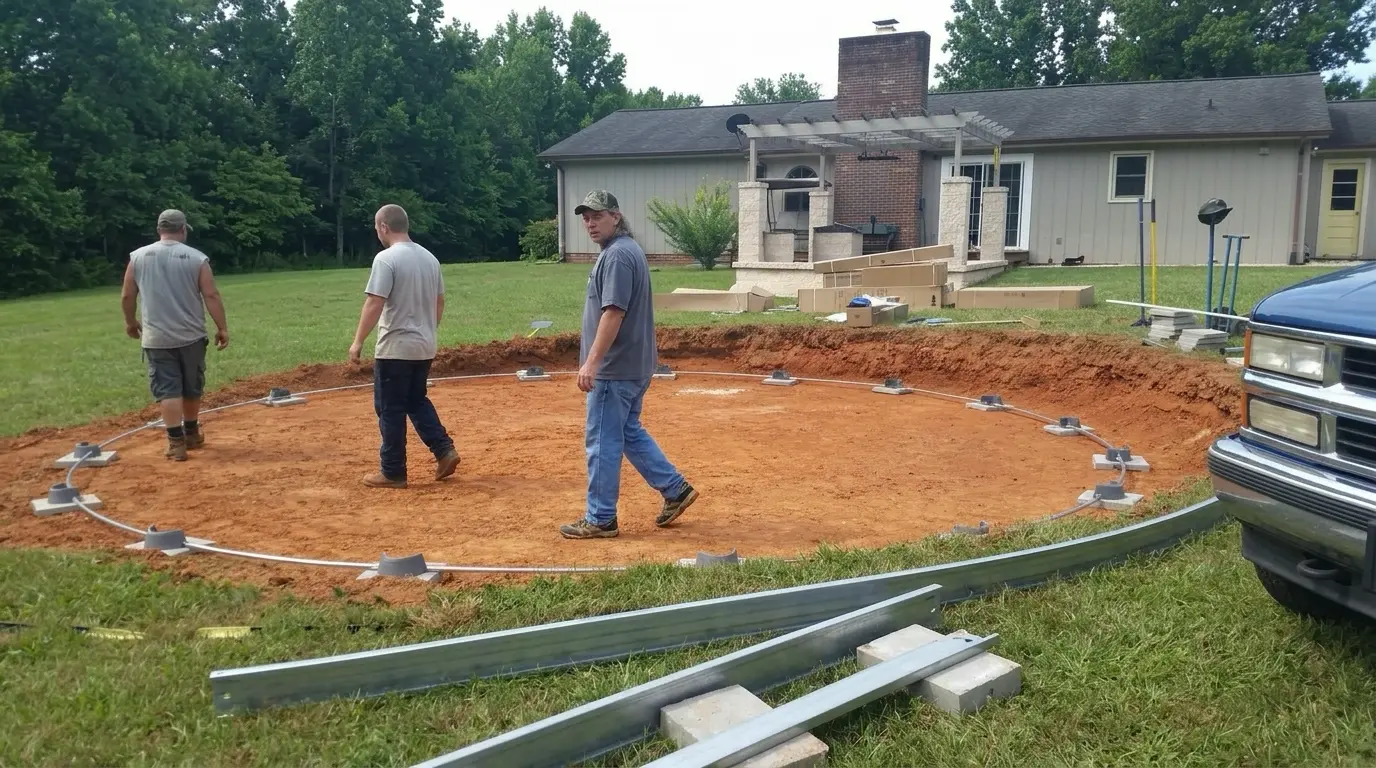
Grass, roots, and organic debris beneath the pool decompose and create soft spots, gas pockets, and an inviting environment for fire ants and burrowing insects. Remove sod and roots down to bare mineral soil across the entire pool footprint plus a 12-inch border. In Florida, this step is especially important because warm, moist soil accelerates decomposition significantly faster than in cooler climates.
Install a Proper Ground Mat or Pad
Never place a Florida above-ground pool liner directly on bare soil or a simple tarp. Use XPS foam board (pink or blue rigid insulation board, 1.5 to 2 inches thick) as your primary liner protection layer. Tape all seams with 3-inch foil tape to prevent boards from shifting under water pressure. This also provides meaningful thermal insulation, which matters in Florida where ground temperatures can draw heat from your pool even in warm weather. See our full guide on weed and ground prep strategies for choosing the right base material.
Address Drainage Around the Pool Perimeter
Florida averages 54 inches of rain per year, with much of it concentrated in intense afternoon thunderstorms during summer. If your pool sits in a low spot or on flat ground with no drainage, water will consistently pool around the base of the frame. This accelerates corrosion on steel frames, undermines the ground beneath your pad, and can create a muddy, mosquito-friendly environment around the pool edge. Ensure the ground slopes at least 1 inch per 4 feet away from the pool in all directions. If your site does not drain naturally, a simple French drain around the pool perimeter is worth the investment.
Place Pavers or Pressure-Treated Lumber Under Frame Legs
Above-ground pool legs concentrate enormous load on a small contact area with the soil. In Florida’s often sandy or moisture-prone soils, this concentrated pressure can cause legs to sink over the course of a season. Place a solid concrete paver or a section of pressure-treated 2×6 lumber under each leg before assembly. This distributes the load and keeps your frame level even as the soil beneath shifts slightly through wet and dry cycles.
The Florida Maintenance Reality
Pool maintenance in Florida is not harder than elsewhere. But it is different in ways that catch new owners off guard. The three variables that define Florida pool chemistry are UV intensity, heat, and rain. Understanding how each one affects your water is what separates a clean, clear pool from a green, cloudy one.
UV Rays and the Vital Role of Cyanuric Acid
This is the single most important chemical concept for Florida pool owners, and it is the one most commonly misunderstood.
Chlorine is your pool’s primary sanitizer. It kills bacteria, oxidizes organic material, and keeps the water safe. But chlorine has a significant vulnerability: ultraviolet light destroys it rapidly. In direct Florida sunlight, an unprotected chlorine dose can be depleted in as little as 60 to 90 minutes.
The solution is cyanuric acid (CYA), also called “pool stabilizer” or “conditioner.” CYA bonds with free chlorine molecules and shields them from UV degradation, extending their effective life from hours to days. Think of CYA as sunscreen for your chlorine.
Target CYA Level for Florida Pools
Maintain cyanuric acid between 30 and 50 ppm in an outdoor Florida pool. Below 30 ppm and your chlorine burns off before it can do its job. Above 80 ppm and the CYA itself begins to reduce chlorine’s effectiveness, a condition called “chlorine lock” where you have chlorine in the water but it cannot sanitize properly. If you are using stabilized chlorine tablets (trichlor), know that they add CYA with every dose. In Florida’s year-round pool season, CYA can accumulate to problematic levels quickly. Test it monthly and dilute with fresh water if it climbs above 70 ppm.
Heat, Rain, and Algae Growth
Extreme Heat Accelerates Everything
Florida summer water temperatures routinely reach 85 to 90 degrees Fahrenheit. Warm water supercharges algae growth and depletes chlorine faster. In peak summer, you may need to dose chlorine more frequently and maintain free chlorine at the higher end of the safe range.
Test chemistry 3x per week in summerHeavy Rain Dilutes and Unbalances
Florida’s afternoon storms can drop 1 to 2 inches of rain in under an hour. That volume of fresh water hitting your pool dilutes chlorine, throws off pH (rainwater is slightly acidic), and introduces organic contaminants from the air and surrounding landscape. Test your chemistry after every significant rain event and re-dose as needed.
Always test after rain over 0.5 inchesOrganic Load from the Environment
Florida’s lush vegetation means leaves, pollen, insects, and organic debris constantly enter the pool. Each of these consumes chlorine as it breaks down. An efficient skimmer and frequent brushing of the pool walls are not optional luxuries in Florida. They are basic maintenance requirements.
Skim and brush every 2 to 3 daysAlgae Can Appear Overnight
In Florida’s warm water, algae blooms do not take a week to develop. A pool that is slightly under-chlorinated on a hot Thursday can be visibly green by Saturday morning. The best treatment is aggressive prevention: consistent chemical levels, regular brushing, and shock dosing after heavy use or rain events.
Shock weekly during peak summerTarget Chemical Levels for Florida Above-Ground Pools
Use the table below as your weekly testing target. These ranges are calibrated for Florida’s climate and are slightly tighter than the generic ranges you will find on most product labels.
| Parameter | Target Range | Florida Notes | Status |
|---|---|---|---|
| pH | 7.2 to 7.6 | Florida tap water often runs high (7.6 to 8.0). Use muriatic acid or pH Down to correct. Low pH corrodes the liner and equipment; high pH reduces chlorine effectiveness. | Critical |
| Free Chlorine | 1 to 3 ppm | Aim for the higher end (2 to 3 ppm) during peak summer when temps exceed 85°F and bather load is heavy. Never let it drop below 1 ppm in Florida summer heat. | Critical |
| Total Alkalinity | 80 to 120 ppm | Alkalinity is the “pH buffer.” Low alkalinity causes pH to swing wildly (common after Florida rain events). Raise with baking soda; lower with muriatic acid. | Important |
| Calcium Hardness | 200 to 400 ppm | Florida’s water is often naturally hard. Very low hardness (soft water) is corrosive to vinyl liners and metal components. Very high hardness causes scaling. Test monthly. | Monitor Monthly |
| Cyanuric Acid (CYA) | 30 to 50 ppm | Essential in Florida’s UV environment. Stabilizer accumulates over time with trichlor tablet use. Do not let it exceed 70 to 80 ppm or chlorine efficiency will degrade significantly. | Critical |
| Combined Chlorine | Below 0.5 ppm | High combined chlorine (chloramines) signals organic overload and is the cause of the “pool smell” and eye irritation. Shock the pool to oxidize chloramines. Target: 0 ppm. | Shock If High |
| Total Dissolved Solids | Below 2000 ppm | In a year-round Florida pool, TDS accumulates from chemicals, sunscreen, sweat, and rain. High TDS reduces chemical efficiency. Partial water replacement is the only remedy. | Annual Check |
Your Weekly Florida Maintenance Routine
Test Chemistry (2 to 3x per week)
- Check pH and free chlorine minimum every other day in summer
- Full panel test (alk, CYA, hardness) weekly
- Always test after heavy rain or high bather load
Physical Maintenance (Every 2 to 3 days)
- Skim surface debris before it sinks and consumes chlorine
- Brush pool walls and floor from top to bottom
- Empty skimmer and pump baskets
- Vacuum after brushing if debris is heavy
Shock Treatment (Weekly in Summer)
- Use calcium hypochlorite (cal-hypo) shock at dusk or after sunset
- Shock after any pool party or high-use day
- Shock after every significant rain event
- Do not swim for 8 to 12 hours after shocking
Equipment Checks (Weekly)
- Verify pump is running at least 8 hours per day (12 in peak summer)
- Check filter pressure and backwash or rinse when needed
- Inspect return jets and skimmer for blockages
- Look for signs of rust on steel frame components after rain
Algae Prevention (Ongoing)
- Never let free chlorine drop below 1 ppm
- Use a weekly algaecide dose as a preventive backstop
- Keep trees and overhanging plants trimmed away from pool area
- Run pump during afternoon peak heat hours when algae growth is fastest
Post-Storm Protocol
- Remove debris before it sinks
- Test pH first (rain acidifies water)
- Rebalance alkalinity and pH before adjusting chlorine
- Shock if combined chlorine rises above 0.5 ppm
The Finish Line: How to Drain Responsibly
Why Proper Draining Matters in Florida
Eventually, every above-ground pool needs to be drained. Whether you are winterizing (though Florida winters rarely require a full drain), replacing the liner, performing repairs, or dealing with TDS or CYA levels that have climbed beyond correction with dilution alone, you will face the task of getting thousands of gallons of water off your property.
In Florida, how you do this matters legally and environmentally. Pool water, even well-maintained pool water, contains chlorine, algaecides, pH adjusters, and other chemical additives that are harmful to aquatic ecosystems. Florida’s extensive network of storm drains flows directly into natural waterways, wetlands, and the Everglades watershed in South Florida. Discharging chlorinated water into storm drains is illegal under Florida Statute 403 and local municipal codes and can carry significant fines.
Step-by-Step: How to Drain Your Above-Ground Pool Correctly
Cease all chemical additions at least five days before you plan to drain. Continue running the pump and letting the sun and natural degradation reduce the chlorine level on their own. Your goal is to get free chlorine below 1 ppm before any water leaves the pool.
If the timeline is tighter, sodium thiosulfate is an inexpensive, safe dechlorinating agent available at pool supply stores. Add it per label directions, wait the recommended contact time, and verify with a test kit that free chlorine reads at or near zero before proceeding. Do not estimate this.
Use a submersible pump or siphon hose to discharge pool water onto a grassy or vegetated area of your property. Grass and soil act as natural filters. Distribute the flow across different areas of the yard rather than saturating one spot, and keep it well away from property lines, drainage swales, and storm drain inlets. Never direct pool water to the street or into a drainage ditch.
Some Florida municipalities allow dechlorinated pool water to be discharged into the sanitary sewer system (not the storm drain, the sanitary sewer) at a controlled rate. This is a completely different system that routes to a water treatment plant. Check with your local utility authority before attempting this route. It is never acceptable to discharge into the storm drain system regardless of chlorine level.
Once drained, let the pool interior dry completely in the sun before folding or storing the liner. Storing a damp liner, even briefly, in Florida’s humidity creates an ideal environment for mildew growth and material degradation. If you are reinstalling the same liner, inspect it carefully for thin spots, brittleness, or cracking while it is fully visible and accessible.
Conclusion: Your Florida Summer Starts Here
Installing an above-ground pool in Florida is absolutely worth doing. Done right, it is one of the best investments you can make in your family’s quality of life and your backyard’s usefulness. The key word is “done right.”
What separates a pool that stays clean and beautiful for years from one that causes constant headaches comes down to three fundamentals: respect the law, prepare the ground properly, and stay ahead of the chemistry. None of these things are complicated. They just require consistent attention and a clear understanding of how Florida’s climate operates differently from everywhere else.
The Florida sun that makes you want a pool in the first place is the same force working against your chlorine every day. The rain that feels like a free gift of water throws your chemistry off balance. The heat that keeps your swimming season going 10 months of the year also keeps algae on a hair trigger. Once you internalize these realities and build a routine around them, maintaining a Florida above-ground pool becomes genuinely low-effort. You test, you adjust, you skim, you enjoy.
That is the full picture. Not a sales pitch, not a scare tactic. Just the honest reality of what it takes and the honest reward on the other side: your own backyard oasis, ready whenever you are, from March through November and sometimes through February.
Frequently Asked Questions
In most Florida municipalities, yes. While the specific requirements vary by county and city, the majority of jurisdictions require a building permit for any residential pool, including above-ground models. The permit process ensures your barrier meets the Florida Residential Swimming Pool Safety Act requirements and that setbacks from property lines are respected. Contact your local building and permitting department before purchasing or installing. The permit application process is typically straightforward and costs between $75 and $250 depending on location.
During Florida’s peak summer months (May through September), test pH and free chlorine a minimum of 2 to 3 times per week. Run a full chemistry panel (including alkalinity, CYA, and calcium hardness) at least once per week. Always test after heavy rain events or high-use days like pool parties. In the cooler months (October through April), once or twice per week testing is typically sufficient. Never go more than three days without checking pH and free chlorine during summer.
For Florida, prioritize a pool with a resin or hybrid (resin/steel) frame rather than an all-steel frame. Resin components are UV-stabilized and will not rust, which matters significantly in Florida’s humid, rain-heavy environment. Steel frames can develop rust at connection points within 2 to 3 seasons in high-humidity coastal areas. For the pool wall, a thicker steel gauge (20 gauge or better) or a resin-walled model holds up better to Florida’s heat, which can expand and contract metal more aggressively than in cooler climates.
Possibly, but this is not a universal rule across Florida. Some counties allow the pool wall itself to serve as the required barrier if it is at least 48 inches tall, has no external horizontal footholds that could aid climbing, and the ladder is removed or secured when the pool is not in use. However, this interpretation varies significantly by jurisdiction. Miami-Dade, for example, has specific requirements that may still mandate a separate perimeter barrier. Always confirm with your local building department rather than assuming the pool wall qualifies. The liability for an unauthorized configuration falls entirely on the homeowner.
Florida algae blooms respond to a consistent multi-step treatment: (1) Test and adjust pH to 7.2 to 7.4 first. Chlorine is significantly less effective outside this range. (2) Shock aggressively with calcium hypochlorite at roughly triple the normal dose for a severe bloom. (3) Brush every surface of the pool thoroughly before and after shocking to break up algae colonies. (4) Run the filter continuously, cleaning it every 6 to 8 hours as it fills with dead algae. (5) Add an algaecide dose 24 hours after shocking. In Florida’s warm water, a severe bloom can be cleared in 24 to 72 hours with this approach. The single biggest mistake is under-shocking. Use enough product to make a real impact on the first treatment.
There is no specific hurricane protocol for pool fencing under Florida law, but standard hurricane preparedness applies to your pool setup. Before a storm, remove all loose items from the pool deck (chairs, umbrellas, toys). Do not drain the pool before a hurricane as the weight of the water actually provides structural stability. Pools are sometimes recommended to be slightly over-filled before a storm to reduce the risk of the liner pulling out. After the storm, test chemistry immediately (storm runoff and debris dramatically unbalance water chemistry) and shock the pool before resuming use.
Ready to Build Your Florida Backyard Oasis?
From ground prep supplies and pool pads to landscaping ideas that complete the look, find everything you need for a successful above-ground pool installation in Florida.
Explore Landscaping & Pool Resources →